Press Notice: Immediate Use
Highland and Island unfriendly is how SNP MSP Rob Gibson summed up the Wednesday's budget.
The Highlands and Islands MSP was commenting after Alasdair Darling announced hikes in duty for fuel and whisky coupled with swingeing cuts to the Scottish Government spending budget and a question mark over where funding for renewable projects such as developments in the Pentland Firth wave and tidal opportunities.
Mr Gibson said….
"There is very little to cheers people or business in the Highlands and Islands."
"Yet again a Chancellor in London has hit the vital industry of whisky with a 2p increase whilst penciling in a 3p rise of fuel over the next year. In short this budget takes more than it gives from the Highland economy."
"The Chancellor has hit the main export from the Highlands and Islands yet again and this time it will be most keenly felt because of the recession. The SNP Government has raised the international profile of whisky as the First Minister did on a recent trip to China, then inexplicably the UK Government target the industry unfairly. This point was rammed home by Gerry O'Donnell director of The Famous Grouse at a reception I hosted in Parliament last night. A collaboration with the RSPB to safeguard the Black Grouse attracts 50p from every bottle of Black Grouse whisky. It does not deserve to fail."
"One criticism of previous Chancellors is that they didn't fully appreciate the price of fuel in remote and rural areas. That cannot be said of the current one who was shocked by the price of a litre of petrol during a recent holiday in the Western Isles. Why therefore did he decide to push through a 2p rise in fuel duty plus an extra percent each subsequent year on the people and businesses of the Highlands and Islands is beyond me."
"However it is sure that this will hinder Highland and Islands firms from emerging from the recession. People who live in remote and rural areas who need their cars more, will also pay more for their fuel and will suffer disproportionately ."
"The news of investment in offshore wind and renewable sector are good news however the Budget is opaque as to where that money will go. If the Labour Party are honest in their commitment to both the Highlands and renewable energy then I expect to see massive investment in the Pentland Firth. As well as ending the step transmission charging regime which makes it far more expensive to produce renewable energy in the North and West than it does in the South."
ENDS
Thursday, 23 April 2009

Tuesday, 21 April 2009
Gibson welcomes business bonus Figures
News release
Immediate release
21/04/09
Over 5000 local businesses have saved over £15,000,000 thanks to the SNP's Scottish Government Small Business Bonus Scheme.
The figures released by the Scottish Government show that in the Highlands 5,642 businesses received a cut in rates.
Highlands and Islands SNP MSP Rob Gibson welcomed the news saying that it will make a real difference….
"This scheme continues to help small local business throughout the Highlands and islands. It shows the SNP's Government support of local businesses which are often the life blood of Scottish Communities."
"This measure was started before the recession but will now serve as a key plank in the recovery from the recession. From the start of this month (As a result of the scheme) ten of thousands of businesses in Scotland will pay no rates what so ever."
"In the tough economic times in which we are in then it is important that more businesses make to most of the scheme. The Government are taking that message to the business community and will work with partners like local authorities to reach as many as possible."
"As has been pointed out to me by a business owner there is a problem with small businesses which have multiple properties. While of course it is right that large chains with many properties are ineligible, John Swinney and his team will look at what more can be done for smaller businesses who find themselves unable to access rates relief due to having more than one property. I am heartened by the Scottish Government intention to undertake a consultation on this issue in due course."
ENDS
Immediate release
21/04/09
Over 5000 local businesses have saved over £15,000,000 thanks to the SNP's Scottish Government Small Business Bonus Scheme.
The figures released by the Scottish Government show that in the Highlands 5,642 businesses received a cut in rates.
Highlands and Islands SNP MSP Rob Gibson welcomed the news saying that it will make a real difference….
"This scheme continues to help small local business throughout the Highlands and islands. It shows the SNP's Government support of local businesses which are often the life blood of Scottish Communities."
"This measure was started before the recession but will now serve as a key plank in the recovery from the recession. From the start of this month (As a result of the scheme) ten of thousands of businesses in Scotland will pay no rates what so ever."
"In the tough economic times in which we are in then it is important that more businesses make to most of the scheme. The Government are taking that message to the business community and will work with partners like local authorities to reach as many as possible."
"As has been pointed out to me by a business owner there is a problem with small businesses which have multiple properties. While of course it is right that large chains with many properties are ineligible, John Swinney and his team will look at what more can be done for smaller businesses who find themselves unable to access rates relief due to having more than one property. I am heartened by the Scottish Government intention to undertake a consultation on this issue in due course."
ENDS
Sunday, 19 April 2009
Gibson calls for NTS land to be given over for allotments
News release
Immediate release
19/04/09
Rob Gibson SNP MSP for Highlands and Islands has called on the struggling National Trust for Scotland to make land available for allotments to help local people grow their own fruit and vegetables.
He said…
"I am writing to the Chief Executive of the National Trust for Scotland to clarify its policy on creating allotments on its land."
"I am aware that the National Trust in England is committed to create 1,000 new allotments on its land down south. Surely the NTS should be doing the same for Scots?"
"Both the NTS and Historic Scotland should meet to discuss how they can boost the cause of home produced food. There must be many hectares in trust that could be put to community use. At a time when the national Scottish Food and Drink policy is taking off and the recession is turning people's thought to saving money, the demand for allotments outstrips supply."
"Highland Council is set to consult on an allotments policy next month. The SNP has identified individual and community support, for example in Inverness. National trust properties can do their bit and earn a small rental income to their coffers from marking out new allotments."
ENDS
Immediate release
19/04/09
Rob Gibson SNP MSP for Highlands and Islands has called on the struggling National Trust for Scotland to make land available for allotments to help local people grow their own fruit and vegetables.
He said…
"I am writing to the Chief Executive of the National Trust for Scotland to clarify its policy on creating allotments on its land."
"I am aware that the National Trust in England is committed to create 1,000 new allotments on its land down south. Surely the NTS should be doing the same for Scots?"
"Both the NTS and Historic Scotland should meet to discuss how they can boost the cause of home produced food. There must be many hectares in trust that could be put to community use. At a time when the national Scottish Food and Drink policy is taking off and the recession is turning people's thought to saving money, the demand for allotments outstrips supply."
"Highland Council is set to consult on an allotments policy next month. The SNP has identified individual and community support, for example in Inverness. National trust properties can do their bit and earn a small rental income to their coffers from marking out new allotments."
ENDS
Wednesday, 15 April 2009
'Crofting Reform Not A Distraction' - Gibson
Rob Gibson SNP MSP for Highlands and Islands has slammed Labour MSPs who try to divert attention from the mess into which crofting sank under previous governments by blaming the SNP Government for implementing key Shucksmith proposals to stabiles crofting population and end the sell off of good crofting land for profit.
He said,
"Highland Labour MSPs think that crofters have a short memory. It was Labour and LibDem ministers in 2007 who attempted to remedy the mess their abortive crofting reform bill left behind. When they set up the Crofting Enquiry under Prof. Shucksmith they sought solutions to the forces undermining crofting. Next month the SNP Government will reveal its law changes to achieve that. Now is not the time to halt that process."
"The current economic crisis is only the tip of a huge iceberg of unresolved problems for crofting which the SNP Government inherited from its predecessors. How can Labour be so crass as to propose that law reform will ignore this economic reality? Crofting can only succeed if fair transport prices are assured for livestock. Also the catastrophic population decline of the Western Isles of 18% in 20 years indicates that the problems have not just arisen through the Downing Street Downturn of the last six months."
"The offer of Labour MSPs to work with Scottish ministers on their terms is merely a headline grabbing distraction. When some of the Shucksmith proposals were accepted by the SNP government and are revealed next month that will be the basis for planning a sustainable future for our least favoured areas.
"LFASS and the SRDP were both planned by Labour and LibDems in the government before 2007. Crofting reform needs to stabilise human lives in the crofting areas as a first step, so absenteeism and bloated land sales of croft land must be curbed and new entrants encouraged to work the land. In a world needing food, the crofters brand will only succeed when comprehensive croft reforms are decided in Parliament."
"New Labour and LibDems can carp all they like, crofting is reaping the whirlwind of their mismanagement which the SNP Government will try to sort out."
Ends
He said,
"Highland Labour MSPs think that crofters have a short memory. It was Labour and LibDem ministers in 2007 who attempted to remedy the mess their abortive crofting reform bill left behind. When they set up the Crofting Enquiry under Prof. Shucksmith they sought solutions to the forces undermining crofting. Next month the SNP Government will reveal its law changes to achieve that. Now is not the time to halt that process."
"The current economic crisis is only the tip of a huge iceberg of unresolved problems for crofting which the SNP Government inherited from its predecessors. How can Labour be so crass as to propose that law reform will ignore this economic reality? Crofting can only succeed if fair transport prices are assured for livestock. Also the catastrophic population decline of the Western Isles of 18% in 20 years indicates that the problems have not just arisen through the Downing Street Downturn of the last six months."
"The offer of Labour MSPs to work with Scottish ministers on their terms is merely a headline grabbing distraction. When some of the Shucksmith proposals were accepted by the SNP government and are revealed next month that will be the basis for planning a sustainable future for our least favoured areas.
"LFASS and the SRDP were both planned by Labour and LibDems in the government before 2007. Crofting reform needs to stabilise human lives in the crofting areas as a first step, so absenteeism and bloated land sales of croft land must be curbed and new entrants encouraged to work the land. In a world needing food, the crofters brand will only succeed when comprehensive croft reforms are decided in Parliament."
"New Labour and LibDems can carp all they like, crofting is reaping the whirlwind of their mismanagement which the SNP Government will try to sort out."
Ends
SUCCESSION LAW PROPOSALS AN IMPROVEMENT
For immediate use; Wednesday 15th April 2009
CHANGES WELCOME BUT COULD GO FURTHER
Highlands and Islands MSP Rob Gibson has welcomed the core proposals of the Scots Law Commission to end the different treatment of moveable and heritable property in the law of succession.
Mr Gibson consulted on a Member's Bill in 2006 to address problems with the law of succession during which time the SLC made proposals to modernise succession law.
Mr Gibson's main goals in amending the existing law were to remove any distinctions between heritable and moveable property, and to equalise the rights of inheritance so that the spouse, civil partners, co-habitees and heirs can succeed to heritable property in the same manner as to moveable property.
Commenting on the SLC report on Succession published today Rob said,
"I am pleased that the SLC has decided to make the rules in its proposals as simple as possible.
"I welcome the right of spouses, civil partners, co-habitees and children to share in the estate of the deceased both in the moveable [house and goods] and heritable [land] property.
"This recognises that the heritable property may be by far the most valuable asset in the estate. In particular the rights of spouses and children are rebalanced so that modern circumstances of more complex family relationships and longer lives are accounted for.
"I recognise the concerns of farmers that their business can be carried on without being divided up. I am confident the SLC has addressed this point of view with clarity.
"However, I am still concerned that the ultimate distinction in law between heritable and moveable property has not been addressed. Nevertheless the rights outlined in the SLC report go a long way to providing the chance for the Parliament to pass modern succession law."
ENDS
1. The Consultation launched by Rob Gibson on a members bill in 2006 is attached; http://www.scottish.parliament.uk/business/bills/pdfs/mb-consultations/LegalRightsOnSuccession.pdf
CHANGES WELCOME BUT COULD GO FURTHER
Highlands and Islands MSP Rob Gibson has welcomed the core proposals of the Scots Law Commission to end the different treatment of moveable and heritable property in the law of succession.
Mr Gibson consulted on a Member's Bill in 2006 to address problems with the law of succession during which time the SLC made proposals to modernise succession law.
Mr Gibson's main goals in amending the existing law were to remove any distinctions between heritable and moveable property, and to equalise the rights of inheritance so that the spouse, civil partners, co-habitees and heirs can succeed to heritable property in the same manner as to moveable property.
Commenting on the SLC report on Succession published today Rob said,
"I am pleased that the SLC has decided to make the rules in its proposals as simple as possible.
"I welcome the right of spouses, civil partners, co-habitees and children to share in the estate of the deceased both in the moveable [house and goods] and heritable [land] property.
"This recognises that the heritable property may be by far the most valuable asset in the estate. In particular the rights of spouses and children are rebalanced so that modern circumstances of more complex family relationships and longer lives are accounted for.
"I recognise the concerns of farmers that their business can be carried on without being divided up. I am confident the SLC has addressed this point of view with clarity.
"However, I am still concerned that the ultimate distinction in law between heritable and moveable property has not been addressed. Nevertheless the rights outlined in the SLC report go a long way to providing the chance for the Parliament to pass modern succession law."
ENDS
1. The Consultation launched by Rob Gibson on a members bill in 2006 is attached; http://www.scottish.parliament.uk/business/bills/pdfs/mb-consultations/LegalRightsOnSuccession.pdf
Sunday, 12 April 2009
Flow Country for World Heritage Status
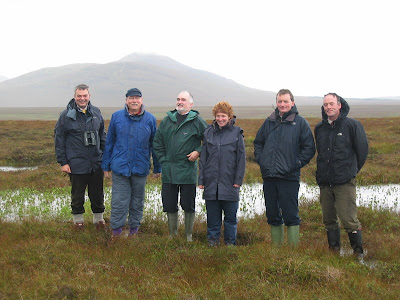
Photo above: Group in the Flow Country - from left: Stuart Howsden Director of RSPB, Rob Gibson MSP, Iain Jardine and Lesley Cranna SNH, George Capbell RSPB, plus another RSPB/SNH representative
The case for the Caithness and Sutherland Flow Country to be put forward as an UNESCO World Heritage Site (WHS) will be aired at the SNP Special Conference this week.
An all encompassng amendment to Conference will include the SNP's Sutherland and Thurso branches' joint amendment for the 1500 square miles 11,000 hectare plus blanket bog to be put forward for candidature for world heritage status. It is merged with a call for similar status to be given to Arbroath Abbey.
Highlands and Islands SNP MSP Rob Gibson who opened the the Flows National Nature reserve in August 2007 has long been a supporter of WHS for the Flow Country said....
"The Flow Country is of great significance not just to the environment of Scotland but also that of Europe. Carbon capture plays a vital part in fighting the effects of climate change and the Flow Country is one of the largest natural occurring natural carbon sinks in the World. For that reason alone it must be recognised worldwide."
"The case for WHS was underlined to me recently when the Economy,Energy and Tourism Committee visited the UHI Environmental Research Institute in Thurso, where Prof Stuart Gibb expanded on the unique size and diversity of species of the blanket bog."
"The Flows is a place of sanctuary or many birds and other species which in itself attracts people to the area. This will help the economy in a remote part of the Country. International recognition will have the dual benefits of protecting the area whilst attracting more people to view the wildlife and rare flora ad fauna which it supports in this wet desert."
"WHS status for the Flow Country is an idea whose time has come. It will become increasingly importantin the future . WHS for the Flow Country is for the world of tomorrow and so work should be started on recognising it today."
"It is incumbent therefore that the UK Government (which is in responsible for nominating candidates for WHS) pushes the Flow Country case for WHS. if it is true that UK Government are considering stopping any future WHS bids then they are not doing the best by the people or the environment they purport to represent especially as we reach the historic conclusion of the Scottish Climate Change Bill in the Parliament."

Ends
Friday, 3 April 2009
FORMER DUNFERMLINE CHIEF EXEC HAS QUESTIONS TO ANSWER
For Immediate Release
– Friday 3rd April 2009
SNP MSP Rob Gibson – a member of the Scottish Parliament’s Economy, Energy and Tourism Committee – has called for the former chief executive of the Dunfermline Building Society Graeme Dalziel to explain comments he made to the committee late last year where he indicating the society was running well and meeting stress-testing requirements.
This is at variance with revelations that the Financial Services Authority was warning that the business was under-capitalised and at risk of failing stress tests.
Commenting Mr Gibson said:
“Looking back at the comments made by Graeme Dalziel about stress testing and saying they had capital to ride out the financial crisis, it seems to me that the timing of this was rather close to the point where the FSA was giving them advice that they didn’t have the capacity to ride it out.
“If so he was either being economical with the truth, or indeed it wasn’t true at all.
“When the fallout from this is dealt with we have to understand why it happened, questions which the First Minister raised about the management of the Dunfermline who had the responsibility.
“It would be a good idea if Mr Dalziel could explain and give some more detail and elaborate on what he meant at the committee meeting.”
ENDS
Notes:
During the Committee hearing Graeme Dalziel said:
“As is the case with other building societies, more than 75 per cent of our funding comes from retail investors, which helps to make the model robust. That is important. When I talk to members up and down the country, I find that they can see how safe a local building society is; they can touch and feel it, and they know that we are putting something back into the community in an economic sense.
“The fact that we are well funded by individual investors means that, at the moment, we are not as pressurised in the wholesale markets.”
"In the two more recent cases, the building societies' assets were not in straightforward prime residential mortgages, but in other things, so the capital base was stretched. Our stress testing shows that we have the capital to withstand and ride out what might be classified as the perfect storm. There is an opportunity for our building society to grow organically in Scotland, as well as south of the border."
The Committee transcript can be accessed here:
http://www.scottish.parliament.uk/s3/committees/eet/or-08/ee08-1802.htm#Col1024
More details are available here:
http://www.holyrood.com/content/view/3774/10051/
– Friday 3rd April 2009
SNP MSP Rob Gibson – a member of the Scottish Parliament’s Economy, Energy and Tourism Committee – has called for the former chief executive of the Dunfermline Building Society Graeme Dalziel to explain comments he made to the committee late last year where he indicating the society was running well and meeting stress-testing requirements.
This is at variance with revelations that the Financial Services Authority was warning that the business was under-capitalised and at risk of failing stress tests.
Commenting Mr Gibson said:
“Looking back at the comments made by Graeme Dalziel about stress testing and saying they had capital to ride out the financial crisis, it seems to me that the timing of this was rather close to the point where the FSA was giving them advice that they didn’t have the capacity to ride it out.
“If so he was either being economical with the truth, or indeed it wasn’t true at all.
“When the fallout from this is dealt with we have to understand why it happened, questions which the First Minister raised about the management of the Dunfermline who had the responsibility.
“It would be a good idea if Mr Dalziel could explain and give some more detail and elaborate on what he meant at the committee meeting.”
ENDS
Notes:
During the Committee hearing Graeme Dalziel said:
“As is the case with other building societies, more than 75 per cent of our funding comes from retail investors, which helps to make the model robust. That is important. When I talk to members up and down the country, I find that they can see how safe a local building society is; they can touch and feel it, and they know that we are putting something back into the community in an economic sense.
“The fact that we are well funded by individual investors means that, at the moment, we are not as pressurised in the wholesale markets.”
"In the two more recent cases, the building societies' assets were not in straightforward prime residential mortgages, but in other things, so the capital base was stretched. Our stress testing shows that we have the capital to withstand and ride out what might be classified as the perfect storm. There is an opportunity for our building society to grow organically in Scotland, as well as south of the border."
The Committee transcript can be accessed here:
http://www.scottish.parliament.uk/s3/committees/eet/or-08/ee08-1802.htm#Col1024
More details are available here:
http://www.holyrood.com/content/view/3774/10051/
Subscribe to:
Comments (Atom)
